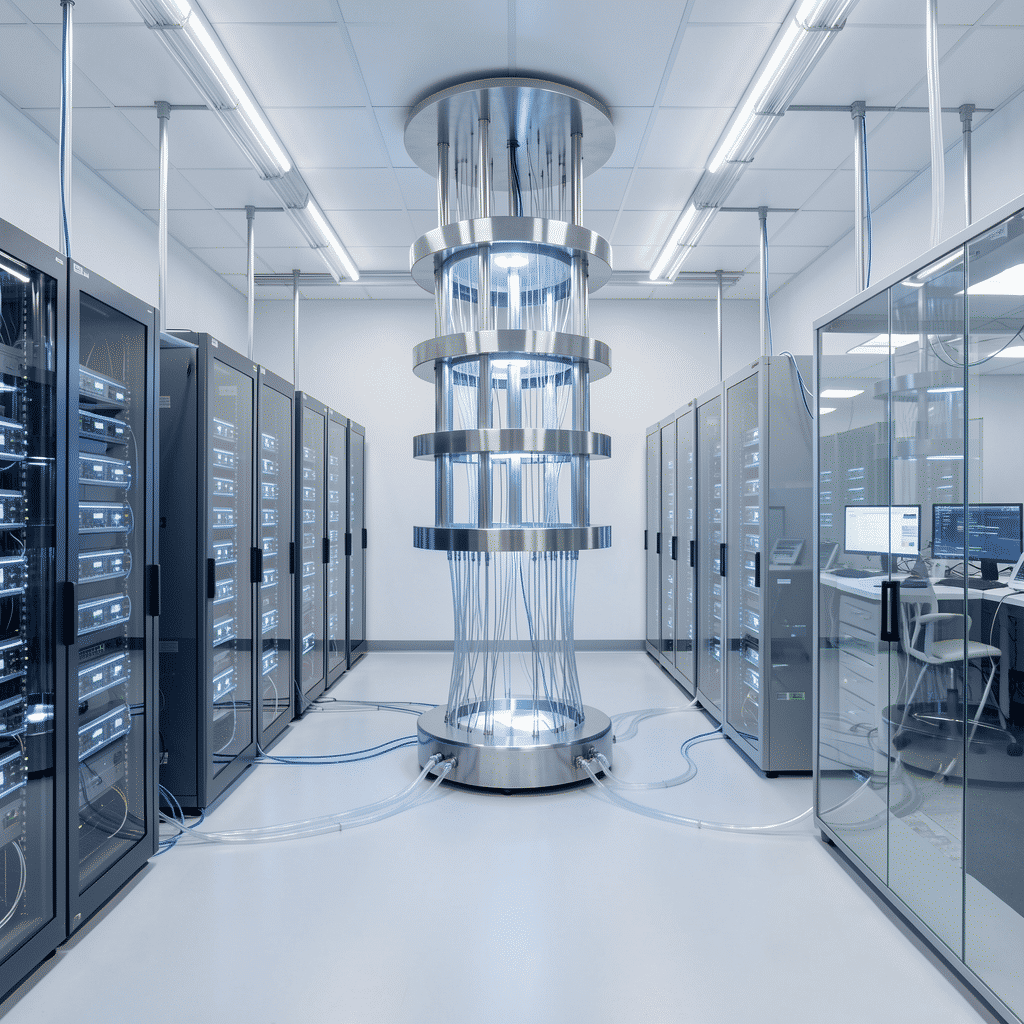
The dawn of quantum computing heralds an era of unprecedented computational power, promising to revolutionize industries ranging from pharmaceuticals to cryptography. Unlike classical computers, which utilize bits as the smallest unit of data, quantum computers leverage the peculiar principles of quantum mechanics to perform operations. Here, the fundamental building block is the quantum bit, or qubit, which has the remarkable ability to exist in multiple states simultaneously—a property known as superposition.
At the heart of quantum computing's transformative potential is this capability to process vast amounts of information much more efficiently than classical systems. While a classical bit is like a traditional light switch, toggling between on and off (0 and 1), a qubit can be in a state that is both on and off at the same time. This duality exponentially increases a quantum computer's processing power, enabling it to solve complex problems far beyond the reach of today's most powerful supercomputers.
Entanglement, another cornerstone of quantum mechanics, further amplifies the power of quantum computing. When qubits become entangled, the state of one qubit instantaneously affects the state of another, regardless of the distance separating them. This interconnectedness allows quantum computers to perform intricate computations at unprecedented speeds, executing a multitude of operations simultaneously.
One area set to benefit massively from quantum technology is drug discovery. The traditional method of testing each potential drug molecule against disease models is a lengthy and costly endeavor. Quantum computing can simulate molecular interactions with astonishing precision, potentially unveiling effective drug candidates and reducing the development cycle significantly. Similarly, in materials science, quantum computers can predict the properties of new materials, catalyzing innovations in everything from battery technology to superconductors.
The field of cryptography also stands on the brink of transformation, as the ability of quantum systems to solve complex mathematical problems at lightning speed threatens to crack modern encryption methods. This development necessitates the creation of new, quantum-resistant cryptographic techniques to secure data against future threats.
Despite these promises, the path forward for quantum computing is not without its challenges. Qubits are highly sensitive to external disturbances, leading to errors in calculations. Maintaining their delicate quantum states—referred to as quantum coherence—requires environments free from noise and disturbances, often achieved through cryogenic temperatures and elaborate shielding systems. Scalability also poses a significant hurdle; increasing the number of qubits while maintaining precise control remains a formidable technical feat.
Yet, researchers and tech giants around the globe are making rapid strides. New algorithms tailored for quantum computers, such as Shor's algorithm for factoring large numbers and Grover's algorithm for database search, are already demonstrating quantum advantage in theoretical scenarios. These quantum algorithms promise to solve what are currently deemed intractable problems, monopolizing tasks that would take classical computers millennia to compute.
As quantum computing matures, it is poised to unleash a wave of innovation, rendering the impossible, possible. Much like the technological revolutions that came before, quantum computing challenges us to rethink the boundaries of what machines can achieve, paving the way for breakthroughs that could redefine the very fabric of modern society. The burgeoning realm of quantum technology stands as a testament to human ingenuity, inviting us to explore a new frontier in computation, limited only by the depth of our imagination.